
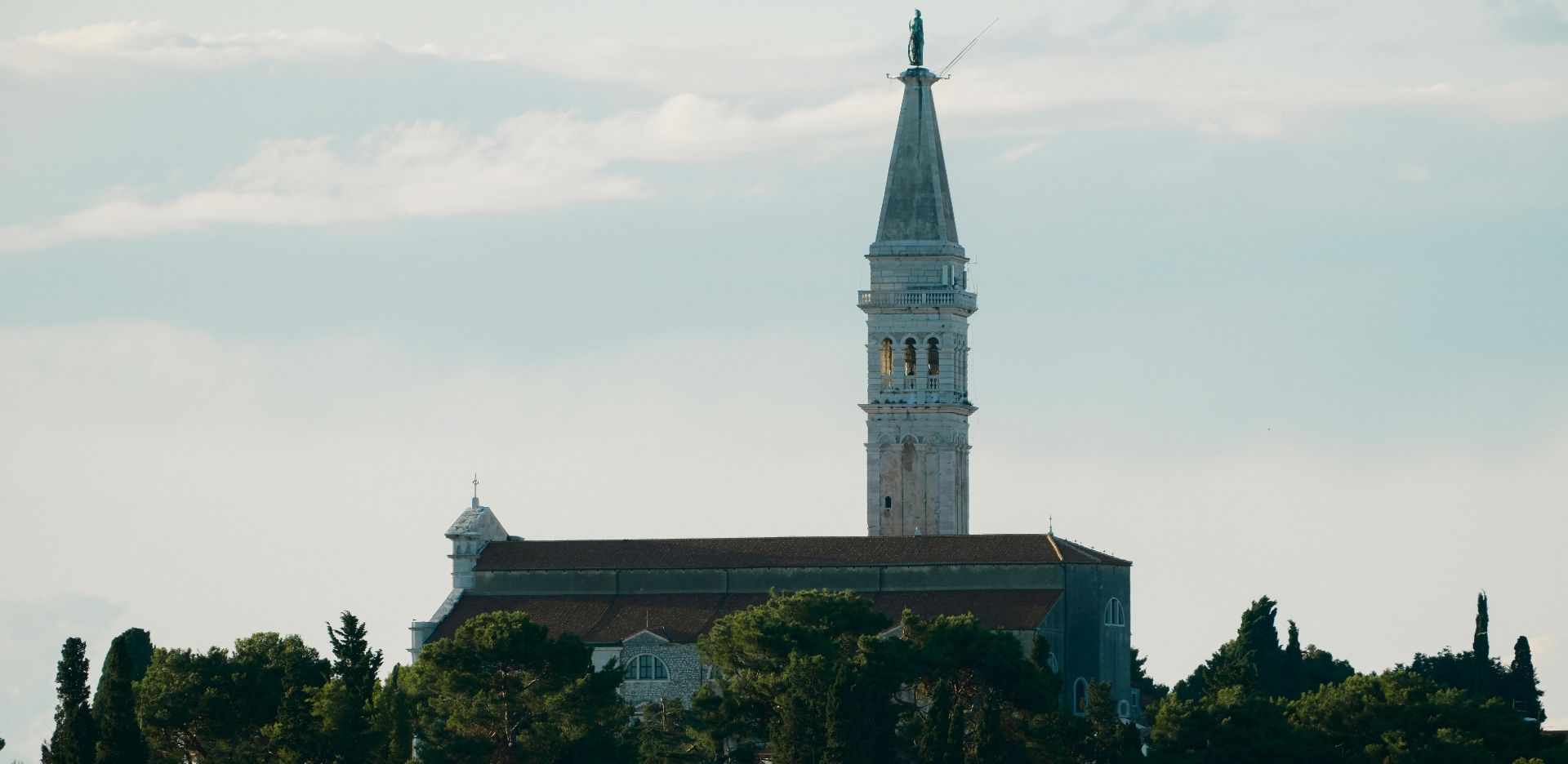
Rising above the rooftops of Rovinj’s Old Town, the bell tower of St. Euphemia Church has watched over the town for centuries. Generations have grown up tracing its silhouette before ever learning the names of the narrow streets below.
At its peak, a copper statue of Saint Euphemia, crafted in the eighteenth century by the Venetian master Zuan Battista Bonazza, crowns the church. She is not fixed in place. She rotates gently in the breeze, always facing away from it, keeping a silent watch over the town and the Adriatic Sea.
For locals and fishermen, she has always been more than a saint. When she turns north, it signals the warm jugo from the south, bringing clouds and humidity. When she faces south, the bora sweeps down from the north, sharp and clear. Long before weather forecasts, people simply looked up to see what she revealed.
The arrival of Saint Euphemia: from legend to tradition
Saint Euphemia was a young Christian martyr from Chalcedon in the fourth century. She was tortured for her faith during the reign of Emperor Diocletian and famously thrown to the lions. Her body was preserved in Constantinople (modern-day Istanbul) until the 7th century, when it was moved to protect it from iconoclasts.
According to local legend, her sarcophagus miraculously appeared off the coast of Rovinj in a boat. The townspeople struggled to move the heavy relics, until, in a moment of divine providence, a small boy arrived with two calves and carried the sarcophagus up the hill to the site where the church now stands.
Over time, a church was built in her honor, and Saint Euphemia became both a spiritual guardian and a symbol of protection for Rovinj, watching over the town through storms, winds, and daily life by the sea. Today, her body is said to rest in the ancient Roman sarcophagus behind the right-hand altar of the Church of St. Euphemia, making it both a place of worship and a historical landmark.
Her presence continues to be celebrated. Every September, Rovinj marks the Feast of Saint Euphemia and City Day with masses, music, food, and community events. One highlight is the annual St. Euphemia Swimming Marathon in Valdaliso Bay, which draws swimmers and spectators from across the Adriatic. These traditions keep her story alive, linking the town’s history with its present-day spirit.
Rising above Rovinj: the church and its bell tower
The Church of St. Euphemia or Sveta Fuma as the locals call it, dominates the skyline of Rovinj with its striking blend of Baroque design and coastal charm. Built over several centuries, the church features a simple yet elegant nave, adorned with altars and frescoes that reflect its Venetian influence. Light filters through the tall windows, illuminating the richly decorated interior and drawing the eye upward toward the bell tower.
From the tower’s viewing platform, visitors can enjoy sweeping panoramas of Rovinj, much of the Istrian coast, and, on clear days, even a glimpse of the bell tower of St. Mark's Basilica in Venice.
The bell tower itself is an architectural marvel, rising nearly 60 meters, it is visible from across the town and the harbor, guiding visitors and locals alike. At its summit stands the statue of Saint Euphemia, mounted on a rotating mechanism that turns with the wind. This combination of art, engineering, and symbolism makes the tower not only a functional structure but also a beacon of Rovinj’s history and identity, connecting the town’s spiritual heritage to its everyday life.
Exploring St. Euphemia: when to visit and what to see
Climbing up to St. Euphemia is a moment to step into Rovinj’s history. The winding cobbled streets of the Old Town are quiet in the early morning, letting you take in the colors and textures of centuries-old stone buildings before the town awakens. By late afternoon, the hill is bathed in golden light, perfect for capturing the red rooftops and shimmering Adriatic on camera.
Inside the church, details that are easy to miss reveal themselves. Visitors can notice the intricate frescoes, the delicate gilding on the altars, and the small inscriptions that reflect generations of devotion. The bell tower climb is an adventure in itself. Narrow steps wind upward to the viewing platform, where the town and the Istrian coast spread out before you. The copper statue of Saint Euphemia slowly turning with the wind feels like a living link to the town’s past.
Guided tours provide a deeper understanding of the church and its history. Visitors can hear the stories behind the art, the legends of Saint Euphemia, and the life of Rovinj through the centuries. Many tours start directly from local apartments, allowing guests to explore the Old Town and the hilltop church at a relaxed pace while discovering details that casual sightseers often miss. Visiting St. Euphemia is as much about the experience as it is about the sights. The climb, the light, and the stories together bring the town’s past vividly to life.
Lorem ipsum dolor sit amet, consectetur adipiscing elit.
In condimentum ex vitae erat pellentesque, interdum hendrerit neque facilisis.
Duis convallis vitae turpis eget posuere.
Nulla ut consectetur nulla.
Donec pulvinar aliquet orci quis euismod.
Praesent ornare neque sit amet faucibus tempor.
Vestibulum vel cursus urna, vel dictum diam.
Lorem ipsum dolor sit amet, consectetur adipiscing elit.
In condimentum ex vitae erat pellentesque, interdum hendrerit neque facilisis.
Duis convallis vitae turpis eget posuere.
Nulla ut consectetur nulla.
Donec pulvinar aliquet orci quis euismod.
Praesent ornare neque sit amet faucibus tempor.
Vestibulum vel cursus urna, vel dictum diam.
Rovinj Tourism
St. Euphemia Swimming Marathon info
Guided tours from local apartments